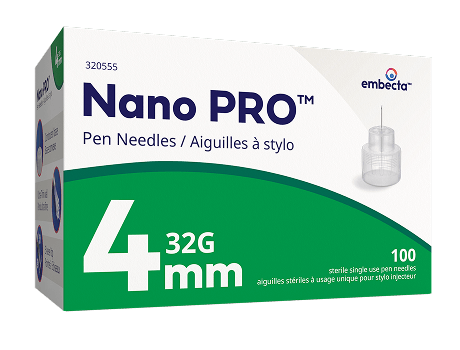
Nano PRO™ Pen Needles are compatible with the Mounjaro and Zepbound KwikPens1†
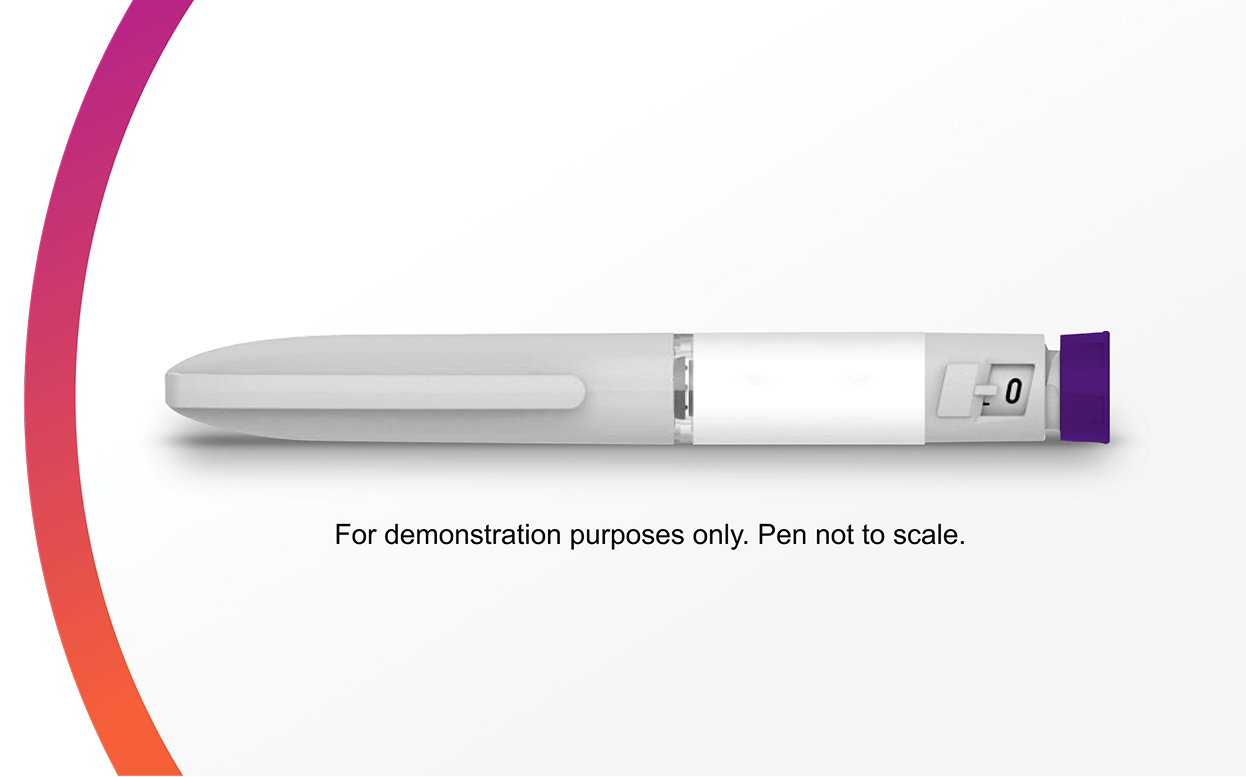
Nano PROTM Pen Needles are compatible with widely used insulin and GLP-1 pen injection devices1‡
Lilly
KwikPen (Basaglar, Humalog, Humulin, Mounjaro, Rezvoglar, Zepbound), Tempo Pen
Novo
Nordisk
Nordisk
FlexPen (Novolin, NovoLog), FlexTouch (Fiasp, Levemir, Tresiba), Ozempic, Saxenda,
Victoza,
Xultophy, NovoPen Echo, Wegovy, Awiqli
Sanofi
SoloStar (Admelog, Apidra, Lantus, Toujeo), Soliqua
Viatris
Semglee
Please refer to the manufacturer's insert that came with the pen device.
This
list is not all-inclusive of all pen compatibility.
Nano PRO™ Pen Needles are the #1 selling pen needle brand in Canada2

Remember! Not all pen injection
devices include pen needles in the box
Ensure that your patients have everything they need for
their injections, including their pen
needles.
Let's stay in touch!
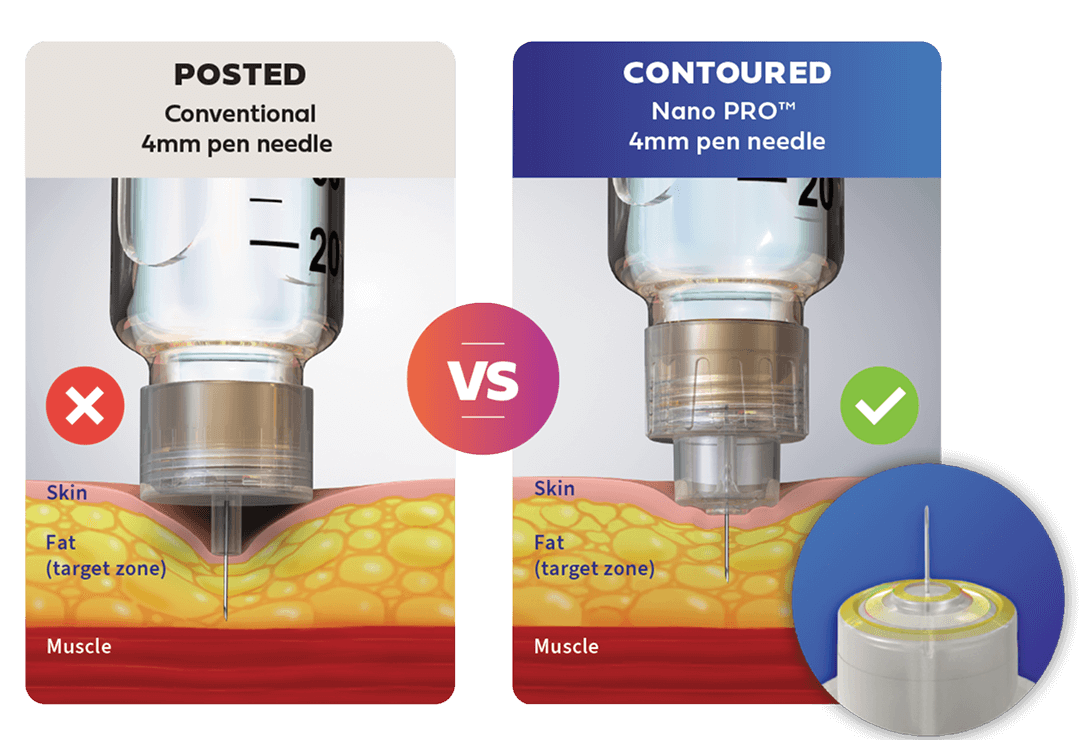
Nano PRO™ Pen Needles can help your patients deliver their insulin correctly3
Nano PRO™ Pen Needles are estimated to reduce intramuscular
injection risk by

vs. other 4mm posted base pen needles.3§

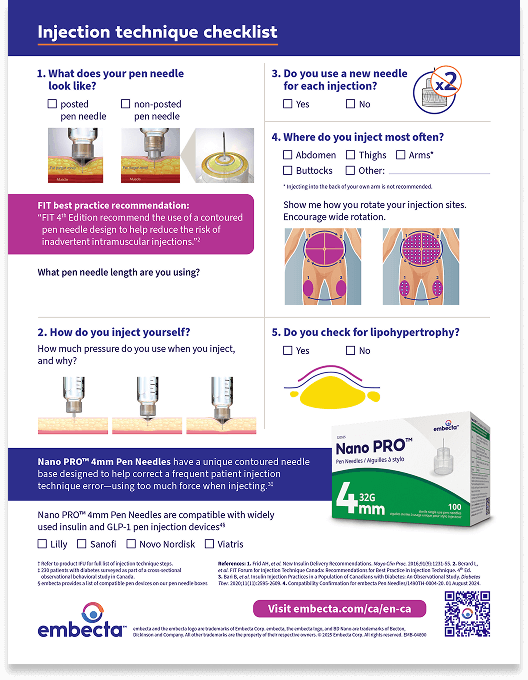
A
patient-friendly resource you can share to help
reinforce key injection techniques and safe needle use.
Explore the unique features of Nano PRO™ Pen Needles
The combination of innovative features on Nano PRO™ Pen Needles was found by people with
diabetes to
significantly reduce overall injection pain and make the injection experience
easier compared to other pen needles studied.4¶
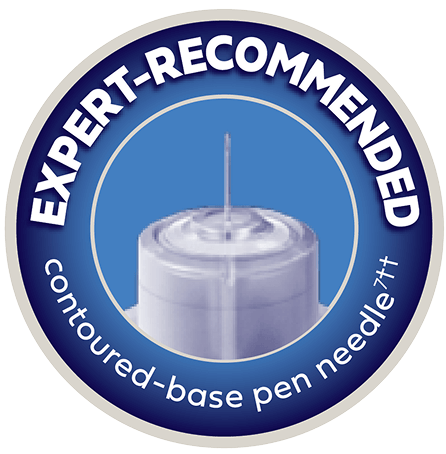
Contoured needle base
The contoured needle base allows for a more consistent 4mm target injection
depth.3§
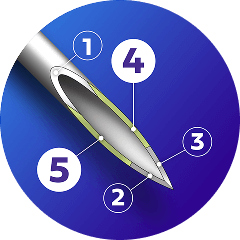
5-bevel tip
The 5-bevel needle tip provides more comfortable and less painful
injections.5#
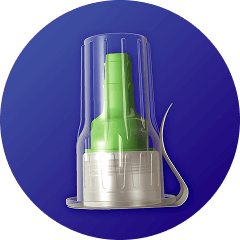
Ergonomic design
The wider outer cover is easier to attach to the pen device, and the
larger
inner needle
shield is easier to grip and remove before an injection.4¶
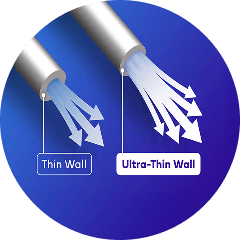
Ultra-thin wall technology
Ultra-thin wall technology for increased flow of insulin and less thumb force required,
giving patients greater confidence the complete dose was
delivered.6‡‡
Help your patients experience the difference of a contoured needle base.3,4
Refill with Nano PRO™ Pen Needles today.
Refill with Nano PRO™ Pen Needles today.
- embecta’s use of third-party trademarks does not indicate any relationship, sponsorship, or endorsement between embecta and the owners of these trademarks.
- Listed brands are owned by third parties.
- To precisely locate injection depth, 1188 injections were administered in swine across a range of clinically relevant injection forces using 20µl of iodinated contrast delivered with Nano PRO™ vs. three 4mm posted-hub pen needles. Intramuscular injection risk was calculated through an in silico probability model, using needle penetration depth and published average human tissue thickness measurements. Measurements were obtained via fluoroscopic imaging. Nano PRO™ more closely achieved the 4mm target injection depth with less variability (p=0.006).
- Results from clinical study assessing patient preferences and feedback.
- 86 patients with diabetes used to evaluate differences between 5-bevel and 3-bevel pen needle tips across pen needles (PN) of equal length and gauge. The 5-bevel PN would be considered more comfortable if the 95% lower bound for the percentage of insertions was greater than the 95% upper bound. After subjects were informed, the 5-bevel PN was selected more often than the 3-bevel PN for greater comfort (p=0.01) in home use. When patients were blinded to the PN bevel designs, no differences were found for ease of insertion (37.1%, 36.8%) or comfort (37.1%, 37.6%).
- A contoured-base pen needle distributes pressure more evenly, reducing the risk of intramuscular injections. While flat-base pen needles are available, currently, there is little to no evidence supporting their impact. See reference 7.
- 198 patients with diabetes were included in this prospective, multicenter, randomized, open-label, 2-period, crossover study to evaluate differences in perceived thumb force and in confidence that the full dose of insulin was delivered, between the participants’ usual pen needle (PN) and the corresponding extra-thin wall (XTW) pen needle while using a manually operated insulin pen. Both outcomes were considered statistically significant if the 95% CI for the mean visual analog scale score was either positive (XTW preferred) or negative (current PN). Significant differences favoring XTW pen needles were seen for perceived thumb force and confidence that the full dose was delivered by 28.4mm (95% CI, 23.7 to 33.2), and 24.4mm (95% CI, 19.7 to 29.1), respectively; (all, p<0.001). Ultra-thin wall was introduced as an ISO standard for inner wall diameter in 2016.
- Compatibility Confirmation for Nano PRO™ Pen Needles/1490TH-0004-20. 18 November 2025.
- Data on file.
- Rini C, et al. Evaluating the impact of human factors and pen needle design on insulin pen injection. J Diabetes Sci Technol. 2019;13(3):533-545.
- Whooley S, et al. Evaluating the user performance and experience with a reengineered 4 mm x 32G pen needle: a randomized trial with similar length/gauge needles. Diabetes Ther. 2019;10(2):697-712.
- Hirsch L, et al. Impact of a modified needle tip geometry on penetration force as well as acceptability, preference, and perceived pain in subjects with diabetes. J Diabetes Sci Technol. 2012;6(2):328-335.
- Aronson R, et al. Insulin pen needles: effects of extra-thin wall needle technology on preference, confidence, and other patient ratings. Clin Ther. 2013;35(7):923-933.
- Klonoff DC, et al. Advance Insulin Injection Technique and Education with FITTER Forward Expert Recommendations. Mayo Clin Proc. 2025; 100(4):682-699.