-

UNITED STATES
North America
South America
Europe
Middle East / Africa
Asia / Pacific

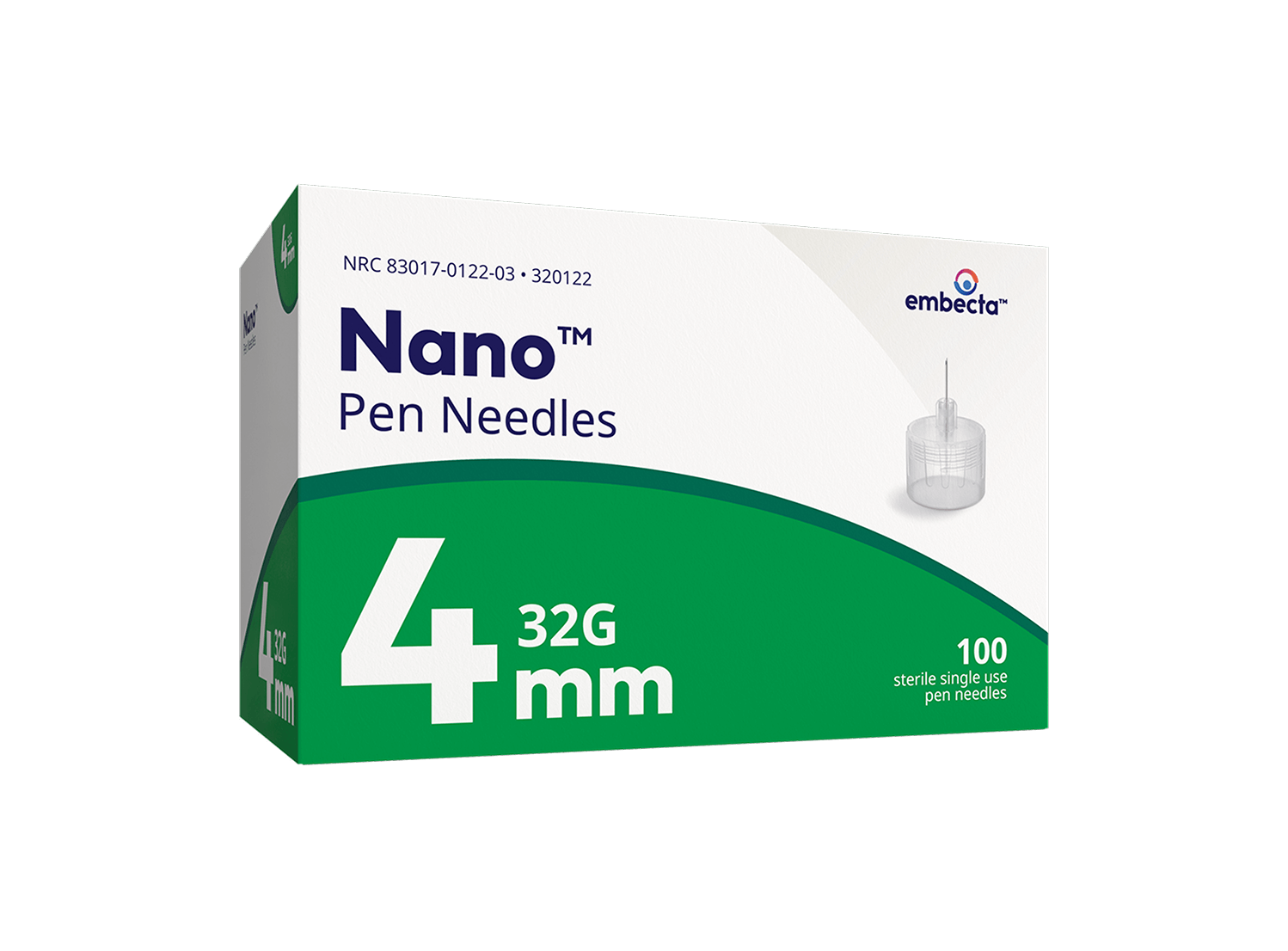
Nano™ 4mm
embecta is committed to helping your patients inject insulin correctly.

- Overview
A recent study showed that people with diabetes were making at least 1 mistake in how they inject insulin.1,2« This can lead to insulin not working the way it should.2
Accuracy
The Nano™ 4mm Pen Needle helps to reduce the risk of injecting into your muscle compared to needles 6mm and longer. 3*
Comfort
The Nano™ 4mm Pen Needle can significantly help reduce pain during injection compared to larger and longer pen needles.4 The 5-bevel needle tip can bring a more comfortable and less painful injection. 5^
Confidence
The Nano™ 4mm Pen Needle has Ultra-Thin wall technology to increase the flow of insulin so less thumb pressure is needed to push the pen button -making it easier to give the injection and giving your patients confidence the full dose of insulin was received.6¥
Compatibility
Nano™ 4mm Pen Needles are compatible with widely used pen injection devices, so even if your regimen changes, you won’t have to change your choice of pen needle.7
Single Use
Use a new pen needle every time you inject. Pen needles are recommended to be used only once and are no longer sterile after that.2
<< N=230 patients with diabetes surveyed as part of a cross-sectional observational behavioral study in Canada.
* Estimates based on 90-degree insertion with no skin pinch-up.
^ 86 patients with diabetes used to evaluate differences between 5-bevel and 3-bevel pen needle tips across pen needles (PN) ofequal length and gauge. The 5-bevel PN would be considered more comfortable if the 95% lower bound for the percentage ofinsertions was greater than the 95% upper bound. The 5-bevel would be considered clinically less painful if the average Visual AnalogScale (VAS) score was at least 10 mm less than for the 3-bevel PN using a 15cm VAS. After subjects were informed, the 5-bevel PN wasselected more often than the 3-bevel PN for greater comfort (p = 0.01) in home use and less pain (mean -36mm) (95% CI -44,-28mm).When patients were blinded to the PN bevel designs, no differences were found for ease of insertion, comfort, or pain.
¥ 198 patients with diabetes were included in this prospective, multicenter, randomized, open-label, 2- period, crossover study toevaluate differences in perceived thumb force and in confidence that the full dose of insulin was delivered, between the participants’usual pen needle (PN) and the corresponding extra-thin wall (XTW) pen needle. Significant differences favoring XTW pen needles were seen for perceived thumb force and confidence that the full dose was delivered by 28.4mm (95% CI, 23.7-33.2), and 24.4mm(95% CI, 19.7-29.1), respectively; (all, P<0.001). Ultra-thin wall was introduced as an ISO standard for inner wall diameter in 2016.
1. Bari B, Corbeil MA, Farooqui H, et al. Insulin injection practices in a population of Canadians with diabetes: an observational study. Diabetes Ther. 2020;11(11):2595-2609.
2. Frid AH, et al. New lnsulin Delivery Recommendations. Mayo Clinic Proceedings. 2016;91(9):1131-1255.
3. Gibney MA, Arce CH, Byron KJ, Hirsch LJ. Skin and subcutaneous a dipose layer thickness in adults with diabetes at sites used for insulininjections: implications for needle length recommendations. Curr Med Res Opin. 2010;26(6):1519-1530.
4. Hirsch LJ, Gibney MA, Albanese J, et al. Comparative glycemic control, safety, and patient ratings for a new 4 mm x 32G insulin pen needle in adults with diabetes. Curr Med Res Opin. 2010;26(6):1531-1541.
5. Hirsch L, Gibney M, Berube J, Manocchio J. Impact of a modified needle tip geometry on penetration force as well as acceptability, preference, and perceived pain in subjects with diabetes. J Diabetes Sci Technol. 2012;6(2):328-335.
6. Aronson R, Gibney MA, Oza K, et al. Insulin pen needles: effects of extra-thin wall needle technology on preference, confidence, and other patient ratings. Clin Ther.2013;35(7):923-933.
7. Pen Needle Compatibility Status Summary with Diabetes Care & Non-Diabetes Drug Delivery Devices. Document Number: 149OTH-0004-20 Rev Y – 2025-11-18.