-

AFRICA
North America
South America
Europe
Middle East / Africa
Asia / Pacific

Micro-Fine™ Pen Needles
embecta is committed to helping your patients inject insulin correctly.
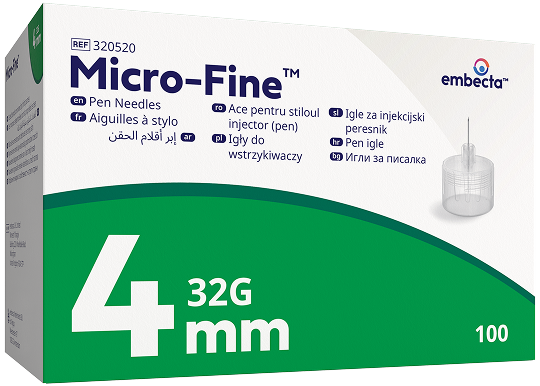


- Overview
A recent study showed that people with diabetes were making at least 1 mistake in how they inject insulin. 1,2<< This can lead to insulin not working the way it should.2
Accuracy
The Micro-Fine™ 4mm Pen Needle helps to reduce the risk of injecting into your muscle compared to needles 6mm and longer.3*
Comfort
The Micro-Fine™ 4mm Pen Needle can significantly help reduce pain during injection compared to larger and longer pen needles.4 The 5-bevel needle tip can bring a more comfortable and less painful injection.5^
Confidence
The Micro-Fine™ 4mm Pen Needle has Ultra-Thin wall technology to increase the flow of insulin so less thumb pressure is needed to push the pen button—making it easier to give the injection and giving your patients confidence the full dose of insulin was received.6¥
Compatibility
Micro-Fine™ 4mm Pen Needles are compatible with widely used pen injection devices, so even if your patient's treatment regimen changes, you wonʼt have to change your choice of pen needle for them.7
Single Use
Use a new pen needle every time you inject. Pen needles are recommended to be used only once and are no longer sterile after that.2
<< 230 patients with diabetes surveyed as part of a cross-sectional observational behavioral study in Canada.
*Estimates based on 90-degree insertion with no skin pinch-up.
^ 86 patients with diabetes used to evaluate differences between 5-bevel and 3-bevel pen needle tips across pen needles (PN) of equal length and gauge. The 5-bevel PN would be considered more comfortable if the 95% lower bound for the percentage of insertions was greater than the 95% upper bound. After subjects were informed, the 5-bevel PN was selected more often than the 3-bevel PN for greater comfort (p = 0.01)in home use. When patients were blinded to the PN bevel designs, no differences were found for ease of insertion (37.1%, 36.8%), comfort (37.1%, 37.6%).
¥ 198 patients with diabetes were included in this prospective, multicenter, randomized, open-label, 2- period, crossover study to evaluate differences in perceived thumb force and in confidence that the full dose of insulin was delivered, between the participants’ usual pen needle (PN) and the corresponding extra-thin wall (XTW) pen needle. Significant differences favoring XTW pen needles were seen for perceived thumb force and confidence that the full dose was delivered by 28.4mm (95% CI, 23.7-33.2), and 24.4mm(95% CI, 19.7-29.1), respectively; (all, P<0.001). Ultra-thin wall was introduced as an ISO standard for inner wall diameter in 2016.
1. Bari B, Corbeil MA, Farooqui H, et al. Insulin injection practices in a population of Canadians with diabetes: an observational study. Diabetes Ther. 2020;11(11):2595-2609.
2. Frid AH, et al. New Insulin Delivery Recommendations. Mayo Clinic Proceedings. 2016;91(9):1131–1255.
3. Gibney MA, Arce CH, Byron KJ, Hirsch LJ. Skin and subcutaneous adipose layer thickness in adults with diabetes at sites used for insulin injections: implications for needle length recommendations. Curr Med Res Opin. 2010;26(6):1519-1530.
4. Hirsch LJ, Gibney MA, Albanese J, et al. Comparative glycemic control, safety, and patient ratings for a new 4 mm x 32G insulin pen needle in adults with diabetes. Curr Med Res Opin. 2010;26(6):1531-1541.
5. Hirsch L, Gibney M, Berube J, Manocchio J. Impact of a modified needle tip geometry on penetration force as well as acceptability, preference, and perceived pain in subjects with diabetes. J Diabetes Sci Technol. 2012;6(2):328-335.
6. Aronson R, Gibney MA, Oza K, et al. Insulin pen needles: effects of extra-thin wall needle technology on preference, confidence, and other patient ratings. Clin Ther.2013;35(7):923-933.
7. Pen Needle Compatibility Status Summary with Diabetes Care & Non-Diabetes Drug Delivery Devices. Document Number: 149OTH-0004-20 Rev Y – 2025-11-18.